
News
“Live by the sword or die by the sword” England’s new mantra
 OPINION
 Follow Us
Win or lose, England do not seem to be in any mood to do away with their attacking approach in limited-overs cricket
“When you look at our top seven, in particular, we've all scored under 60-ball hundreds. That's the way we want to play. With one eye on the WC, we want to try and push the envelope in that regard. Sometimes it doesn't work. But for us, it's better to lose like that than losing by 10-20 runs. That's the way we'll continue playing”.
The words from Eoin Morgan in the post-match presentation from the first ODI, said a lot about the new approach of England. The change in approach came post the 2015 World Cup. Prior to that, across three different five-year phases since 2001, England were nowhere near to what they are today. From 2001 till 2005, they had scored at a run rate of 4.9. In the next five, 5.1 and from 2011 till the 2015 WC they had scored at 5.3.
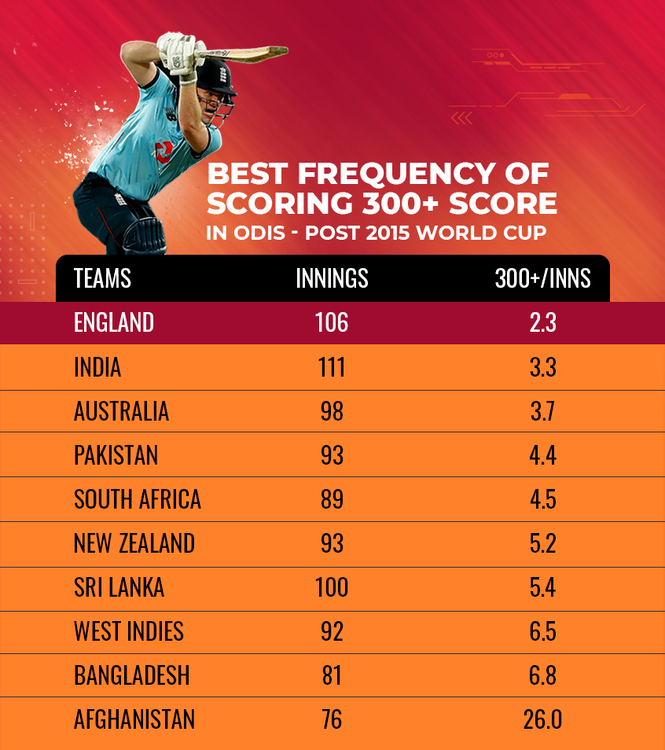
After crashing out in the league stages of the World Cup, the aftermath of their recovery was exceptional. Post the 2015 World Cup, England have scored at a run rate of 6.3, which is the highest among all the teams. Hence, scoring 300+ runs in an innings became a common feat for England. Since the first ODI till the 2015 WC, England had scored over 300 for 34 times in 644 ODI matches they had played. Only Zimbabwe (21) and Bangladesh (7) had scored lesser than them amongst the then Test-playing nations. However, post the 2015 World Cup, England have scored a total of 300+ in 47 out of the 106 innings they have played, the most among all the teams. This meant, for every 2.3 innings they had amassed a total of 300+, the most frequent among all the teams.
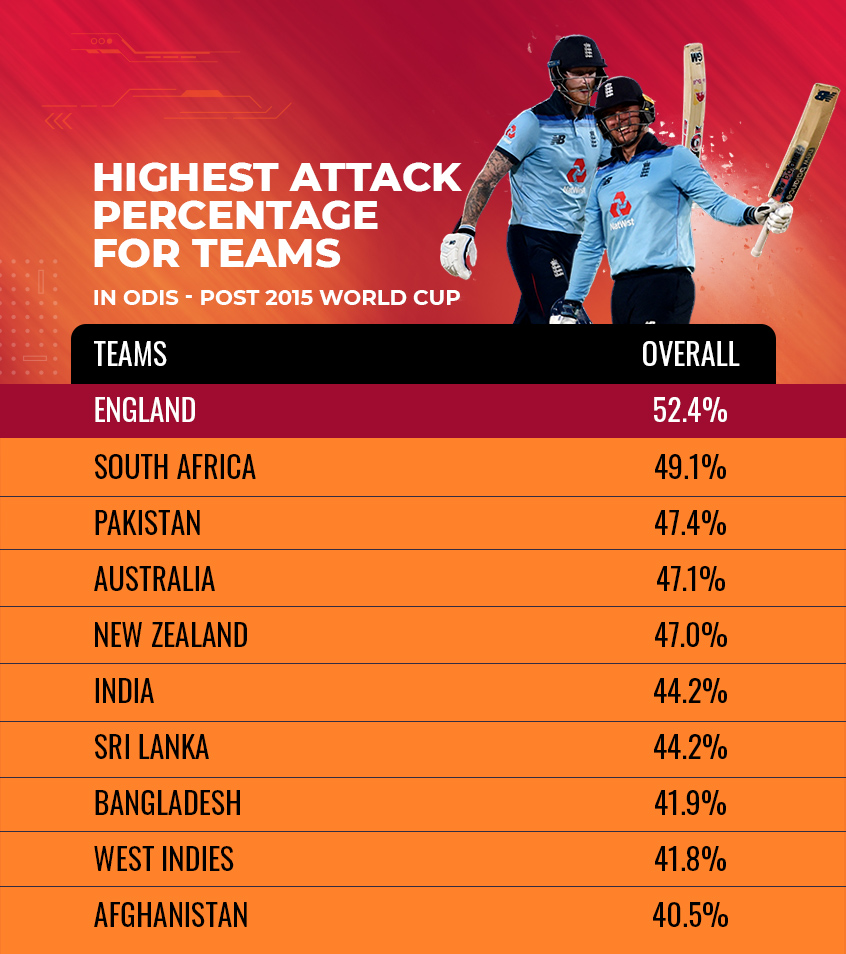
The attacking instinct of the English batsmen is certainly one of the factors behind their huge totals. Among the top 10 teams, their batsmen have the highest attack percentage (52.4) in this time frame. No other teams have an attack percentage of more than 50, apart from them. Even in the middle overs phase (Overs 11-40), their intent to pounce on the bowlers is something that is admirable.
BOUNDARIES FLOW LIKE WATER
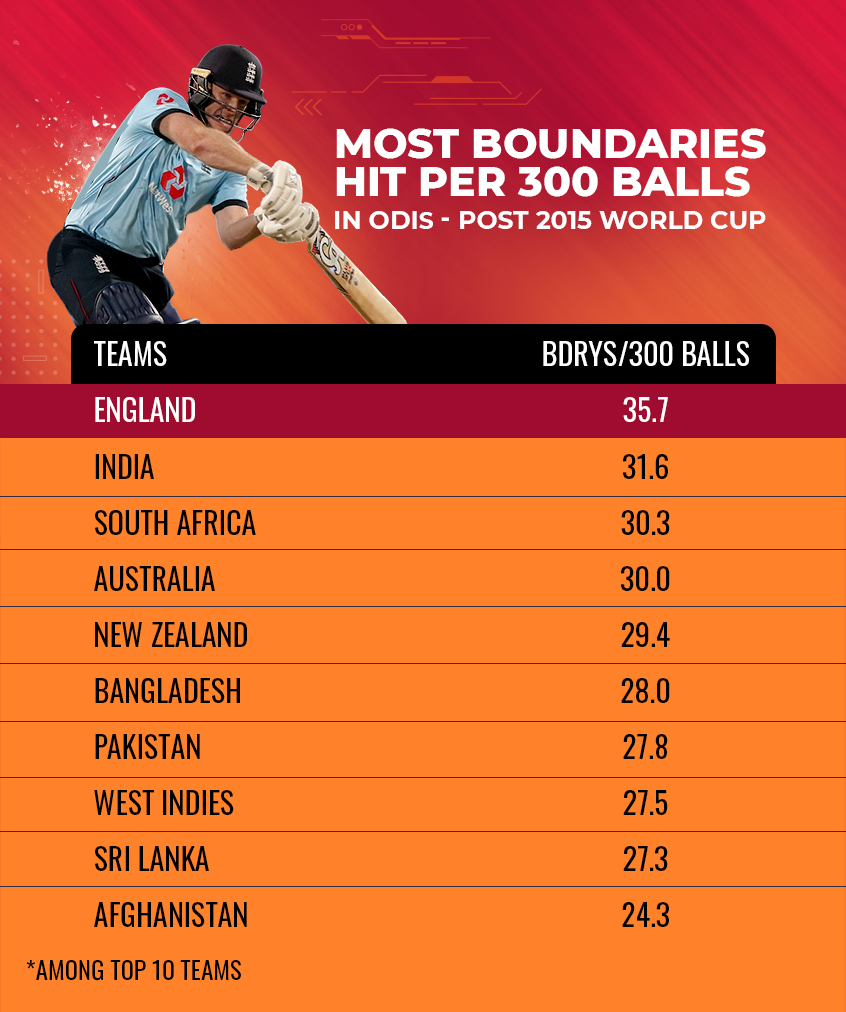
By virtue of an aggressive approach, the boundaries have flown with ease for the English batsmen. Post-2015 World Cup, England batsmen have struck 2660 fours and 655 sixes, which is the most for a team. Their batsmen have scored 50.2 percent of their runs through boundaries each coming in every 8.4 balls, the most frequent among all teams. Their percentage of runs through boundaries is also the highest. In every phase of the game, England batsmen have hit a boundary in a span of 10 balls. No other teams have done this. England batsmen have smashed 35.7 boundaries per innings post-2015 World Cup. On average, teams have scored 28.8 boundaries in an innings. England batsmen have scored 6.9 more boundaries than other team batsmen in this time frame.
Another commendable aspect of their batsmen is to clear the ropes and 655 sixes being the most by a margin is proof of it. Their batsmen have managed to hit a six every 42.6 balls, which is the second-best among the top 10 teams.
A LAUDABLE IMPROVEMENT
The biggest improvement of all from their previous years was their approach towards the spinners. From 2001 till the World Cup 2015, England batsmen had scored 31.3 percent of their runs through boundaries against the spinners with a balls/boundary ratio of 17.2. Though their run-rate was just above par, their ability to score boundaries was under the pump. But, post the World Cup, everything changed. England batsmen are now scoring 45.9 percent of their runs through boundaries and they have scored a boundary every 9.8 balls. This is the best among the top 10 teams.
In recent times, without any element of doubt, their approach has proven right for them most of the time. A win percentage of 68.9 percent post World Cup 2015 as compared to 49.6 percent prior, is a testament to their approach.